
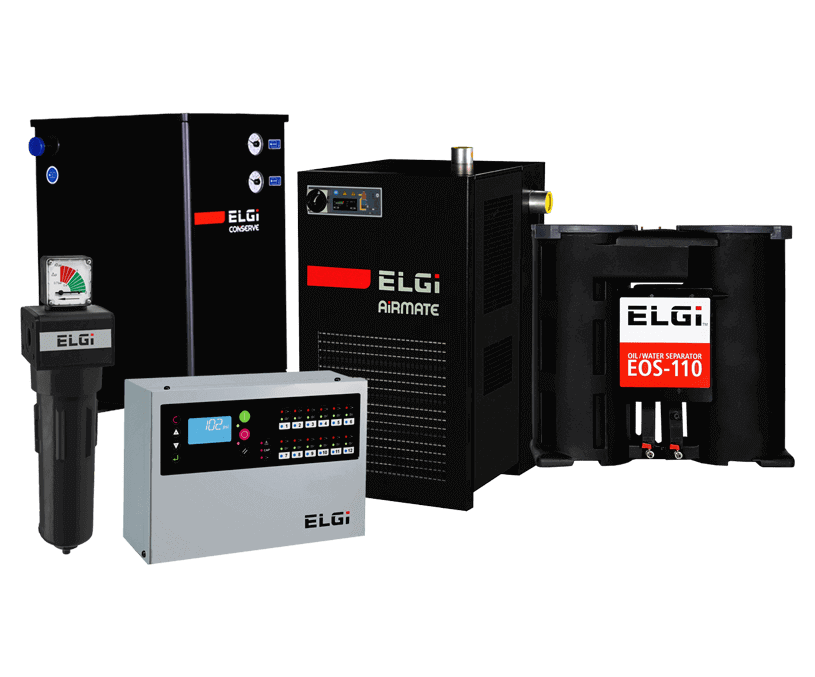
ELGi Compressed Air Dryers, Filters & Accessories
Protect Your Equipment With the Right Compressed Air Quality
Water at a workstation, premature element changes or pressure loss across treatment equipment can point to a mismatch between the application and the installed air-treatment system. Before choosing another dryer or filter, document the symptom and the conditions under which it occurs. The most useful starting point is what the process receives and what it requires.
Application insight
Start with the air-quality symptom
Water at an air drop, a pressure loss and oil at the process require different investigations. Record where the symptom appears and the conditions when it occurs. Those observations help connect dryer and filter selection to the result needed at the point of use.
Water appears in warmer conditions
Record the dryer inlet temperature, operating pressure, surrounding temperature and airflow information available when the problem occurs. ELGi identifies these conditions as factors in dryer capacity. A unit that appears adequate during light demand or cool weather may face a different moisture load during busy summer operation.
Pressure falls across treatment
Note the pressure before and after the relevant component while the system is supplying air. Include filter age, condition indicators and recent changes in demand. Increasing compressor pressure without investigating the loss can leave the underlying restriction or sizing issue unresolved.
Oil or contamination reaches the process
Describe what was observed and where, rather than assuming every contaminant needs the same filter. Liquid droplets, aerosols, particles and vapor call for different treatment considerations. Share any test results and the required outlet quality so the filter discussion is tied to the actual contaminant.
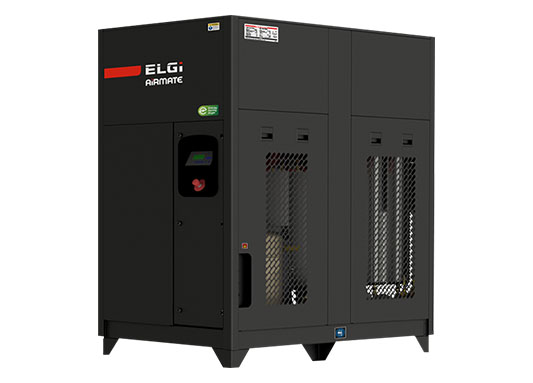
ELGi AR Premium Series Cycling Refrigerated Air Dryers
100–5,000 CFM | ISO 8573-1 Water Class 4
For facilities with changing compressed air demand, the ELGi AR Premium Series combines moisture removal with energy-saving cycling technology.
Rather than operating the refrigeration system continuously regardless of demand, the AR Premium Series stores cooling energy and uses it during partial-load conditions. This allows the refrigeration compressor and fan motors to shut off in ECO Mode while maintaining the required pressure dew point.
The result is a refrigerated compressed air dryer designed to meet ISO 8573-1 water Class 4 requirements under its specified operating conditions while reducing unnecessary energy consumption when demand drops.
AR Premium Series Highlights:
- 100–5,000 CFM
- Designed for ISO 8573-1 water Class 4 under specified operating conditions
- Energy-saving cycling operation
- ECO Mode for partial- and no-load conditions
- Automatic condensate drain
- Smart controller
- Integrated filtration on applicable models
- High-efficiency heat exchanger
- Designed to reduce energy use as compressed air demand changes
AR Premium Series Technical Details
The AR Premium Series uses thermal mass technology to store cooling energy during normal operation.
During periods of reduced compressed air demand, the dryer can use this stored cooling capacity while switching off the refrigeration compressor and fan motors, helping reduce energy consumption.
An automatic condensate drain removes collected moisture with no compressed air loss and minimal maintenance.
The dryer controller provides information including:
- Pressure dew point
- ECO Mode status
- Total operating hours
- Fan operation
- Inlet air temperature
- Ambient temperature
- Maintenance intervals
Applicable models through AR 2350P can incorporate:
- Inlet pre-filter: Removes particles to 1 micron and oil to 0.1 ppm
- Outlet fine filter: Removes particles to 0.1 micron and oil to 0.01 ppm
Integrated filtration can reduce additional piping and external filter requirements.
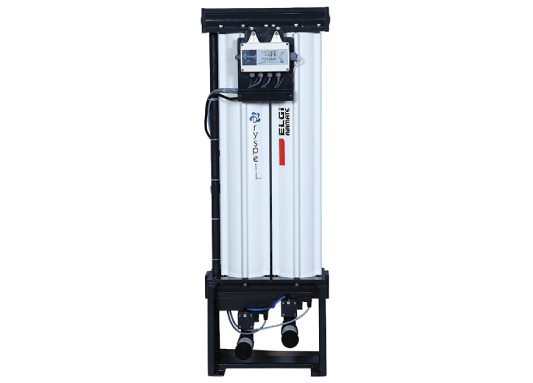
ELGi HLD Series Modular Desiccant Air Dryers
10–375 CFM | Down to -40°F Pressure Dew Point
When your process requires air that is significantly drier than a refrigerated dryer can provide, the ELGi HLD Series uses desiccant technology to remove moisture and water vapor to a pressure dew point as low as -40°F.
The heatless twin-tower design is intended to meet ISO 8573-1 water Class 2 pressure-dew-point requirements under its specified operating conditions. Applications can include painting, powder coating, pharmaceutical production, laboratories, glass manufacturing, semiconductor processes and food production. Particle, oil and any microbiological requirements must be assessed separately for the application.
HLD Series Highlights:
- 10–375 CFM
- Pressure dew point down to -40°F
- Designed for ISO 8573-1 water Class 2 under specified operating conditions
- Heatless twin-tower design
- Energy-saving purge optimizer
- Optional dew point control
- High-performance filtration
- Mixed-bed desiccant
- CE and CRN certified
HLD Series Technical Details
Compressed air passes through a tower containing desiccant material that adsorbs moisture from the air stream.
While one tower dries the compressed air, the second tower regenerates. The towers alternate operation to provide a continuous supply of dry compressed air.
Because compressed air demand and moisture load do not always remain at maximum levels, the HLD Series can adjust purge-air use based on operating conditions.
Available purge optimization settings include:
- 40%
- 60%
- 80%
- 100%
This helps reduce unnecessary compressed air consumption during regeneration.
An optional dew point stretch cycle uses an outlet dew point measurement to extend drying cycles when conditions allow, helping further reduce purge-air consumption.
High-performance filters supplied with the HLD Series can remove:
- Wet particles down to 0.01 micron
- Oil aerosols down to 0.01 mg/m³
The HLD Series uses a mixed desiccant bed combining activated alumina and molecular sieve to provide high moisture adsorption performance.
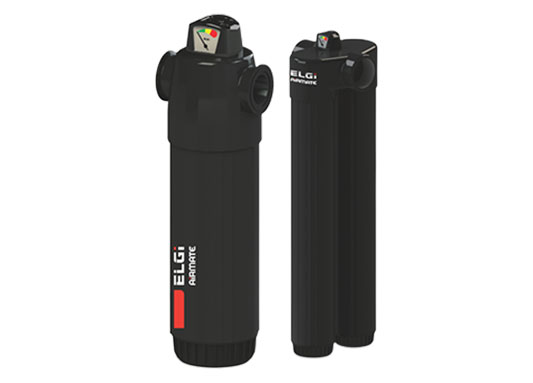
ELGi AF Series Downstream Compressed Air Filters
21–6,475 CFM
The ELGi AF Series provides downstream compressed air filtration for applications where particles, water, oil aerosols or oil vapor need to be removed before compressed air reaches equipment or processes.
ELGi offers multiple filtration grades so the treatment system can be matched to the required compressed air quality rather than applying the same level of filtration to every application.
AF Series Highlights:
- 21–6,475 CFM
- Multiple filtration grades
- Particle removal down to 0.01 micron
- Oil aerosol removal for higher-purity applications
- Activated carbon filtration available
- Corrosion-resistant filter housing treatment
- Differential pressure and filter-status indication
- Automatic internal float drain
- Zero-loss drain option
- Compact housing design
- 10-year filter housing warranty
- CE, AS, CRN and ASME certifications
AF Series Technical Details
The PF filter is a general-purpose filtration stage designed to remove particles down to 1 micron, including coalesced liquid water and oil.
The FF filter provides higher-efficiency filtration for removing particles down to 0.01 micron, including water and oil aerosols.
The CF filter uses activated carbon to remove oil vapor and hydrocarbon odor from the compressed air stream.
A differential pressure gauge and filter-status indicator help operators monitor element condition and plan maintenance.
An integrated service indicator also provides a reminder when maintenance is required.
The standard internal float drain automatically removes accumulated condensate while minimizing compressed air loss.
Zero-loss condensate drain options are also available.
ELGi uses a corrosion-resistant treatment on AIRMATE filter housings to help prevent housing corrosion from introducing additional particles into the compressed air stream.
Why Choose ELGi Compressed Air Accessories?
The equipment downstream of your compressor can have a major impact on reliability, air quality and operating cost.
Get the Air Quality Your Process Requires
ELGi offers refrigerated and desiccant dryers along with multiple filtration grades, allowing the treatment system to be matched to the moisture, particle and oil limits required by your application.
Protect the Equipment Downstream
Removing moisture, particles and oil contaminants can help reduce corrosion, protect pneumatic equipment and prevent contaminants from reaching sensitive processes.
Reduce Unnecessary Energy & Air Loss
Energy-saving cycling dryers, purge optimization and zero-loss condensate management options are designed to reduce the amount of energy or compressed air consumed simply to treat the air.
Build the Air Treatment Around Your Process
The right compressed air system does more than produce enough CFM.
It needs to deliver air at the pressure, dryness and purity your equipment and process require.
Fluid Flow can help evaluate your compressor capacity, operating conditions and compressed air quality requirements and determine which ELGi dryers, filters and condensate management equipment belong in the system.
Compare your options
Specify the complete treatment train
Specify the outlet air quality and the actual conditions entering the treatment train. Include retained equipment and its sequence: a new dryer or filter must work with the separators, drains and other stages already installed.
- State the required dryness and the particle and oil limits for the application, including the source of those requirements.
- Provide normal and maximum airflow, operating pressure, inlet-air temperature and the installation environment.
- List installed separators, dryers, filters and drains in their current sequence.
- Identify measured pressure loss, dew-point readings, alarms and maintenance performed before the symptom appeared.
- Describe the process impact of a treatment interruption and the time available for maintenance.
Useful answers
Air-treatment questions
The compressor’s airflow is part of the calculation, but the dryer’s published capacity has reference conditions. Actual pressure and temperatures can change the capacity required. Review the manufacturer’s selection information for the intended conditions before choosing a dryer with a matching nominal airflow.
No. Coalescing filtration addresses liquid aerosols; drying addresses the moisture vapor requirement. A filter and a dryer perform different jobs. Select their combination around the specified outlet air quality and the equipment manufacturer’s installation guidance.
Include the inlet protection, outlet filtration and air used for regeneration. The HLD’s heatless drying process uses purge air, so the compressor-system review should account for that consumption. Ask how the proposed controls, operating pattern and maintenance requirements affect the complete installation.
Complete the compressed-air system
product
ELGi Industrial Air Compressors
Review compressor families alongside the treatment they will supply.
product
ELGi Oil-Lubricated Rotary Screw Air Compressors
Match the compressor duty and controls to the plant demand profile.
product
ELGi Oil-Free Screw Air Compressors
Keep oil quality, moisture and particles distinct in the air specification.
service
Compressed Air Audits
Use operating evidence to investigate pressure or air-quality concerns.
Fluid Flow application support
Discuss your air-treatment requirement
Share your air-quality target, installed equipment and operating symptoms with Fluid Flow. We can discuss ELGi dryer and filter options using those details and identify the additional information needed for a treatment selection.