
Instrumentation & Valves
Dwyer Pressure & Flow Instruments
Dwyer pressure and flow instruments support filter monitoring, airflow checks and process measurement. Fluid Flow can help select a local gauge, transmitted reading or flow instrument around the operating condition your team needs to see.

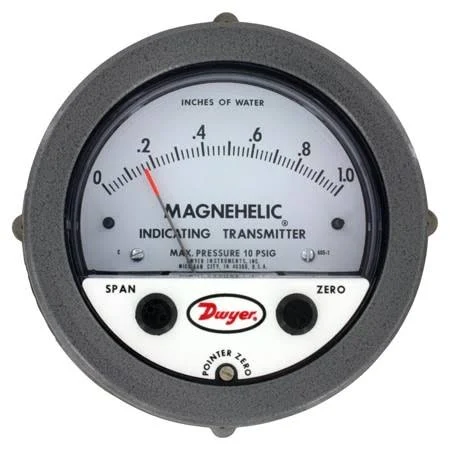
Explore Dwyer Instruments products
Choose local indication, a control-system signal or a flow-monitoring function.
Differential-pressure gauges
Read the pressure difference across a filter or between two air-system points. Magnehelic gauges provide local indication without a powered display.
- Define the expected differential-pressure range.
- Confirm media compatibility and maximum applied pressure.
- Locate the dial where operators can read it.
Differential-pressure transmitters
Bring low differential-pressure measurements into a building or process control system. Indicating transmitters can combine a local reading with an electrical output.
- Match range and output to the controller.
- Confirm power supply and wiring.
- Review sensing-line routing and mounting.
Air, gas and liquid flow measurement
Measure or monitor fluid movement using a technology suited to the service. Dwyer flow products include meter, switch and rate/totalizer functions.
- Identify the fluid and required flow range.
- Review pipe or duct installation details.
- Choose indication, alarm, rate or totalization functions.
Start with your operating requirements.
Define what the reading represents
A filter differential, room pressure and duct static pressure are different tasks. State the process points and the decision the measurement will support.
Size the range around normal operation
Provide normal and maximum pressure difference or flow. Include expected startup conditions and the limit that requires an alarm.
Connect the measurement to the controls
Specify local-only indication, an analog signal or switch output. Review the receiving controller, available power and installation location.
Frequently asked questions
It measures the difference between two pressure points. In filter monitoring, this is the pressure drop across the filter at the operating flow. It is different from measuring the pressure of a single line.
A standard mechanical gauge provides a local reading. A separate indicating-transmitter configuration, such as the Series 605, is designed to add an electrical output. Check the exact model before planning the connection.
A switch changes state at a flow condition; a meter reports flow over a range. Select the function based on whether the equipment needs an alarm, a continuous value or both.
Contact your local Fluid Flow team to confirm product availability and options for your facility.
Find the right solution for your application.
Share your operating requirements, current equipment and facility location.