Instrumentation & Valves
Drexelbrook Level Measurement & Controls
Drexelbrook instruments help monitor material level in tanks and vessels and detect defined level conditions. Fluid Flow can help compare contact and non-contact technologies around the material, vessel geometry and required control function.

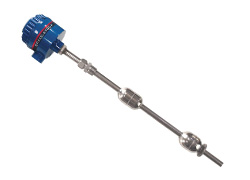
Explore Drexelbrook products
Match the required level function to the material and vessel conditions.
RF admittance level transmitters
Use a probe-based measurement approach for continuous level applications. The sensor and configuration need to match the material and installation.
- Describe conductivity, dielectric properties and coating.
- Specify the measuring span and probe arrangement.
- Review pressure, temperature and process connections.
Non-contact level measurement
Evaluate ultrasonic or open-air radar for installations where a sensor above the material is preferred. Vessel conditions influence the measurement path.
- Identify foam, vapor, dust and surface turbulence.
- Provide nozzle geometry and internal obstructions.
- Review the required span and mounting position.
Point-level controls
Detect a high or low level at a defined location. RF admittance point-level products support a range of material-monitoring duties.
- State the switching location and required response.
- Describe buildup and changing material properties.
- Match sensor construction and outputs to the process.
Start with your operating requirements.
Characterize the material
Identify liquid, slurry or bulk-solid service and explain changes in composition, coating, moisture or density. These can be more decisive than tank height alone.
Share a vessel sketch
Include height, nozzles, obstructions, agitators and access. Mark the measuring span and any independent alarm points.
Define the operating objective
State whether you need continuous level, inventory indication or a high/low-level response. Specify the control-system input and environmental requirements.
Product resources
Frequently asked questions
Point-level instruments detect a defined condition or location. Continuous instruments provide a changing value across a span. Select the function that supports the operator or control-system decision.
It can be useful when avoiding a probe in the material is desirable. Foam, vapor, dust, surface behavior and vessel geometry still need review before selecting ultrasonic or radar measurement.
Describe the material, coating thickness and consistency, process temperature, cleaning cycle and sensor location. Photographs and operating history help narrow the sensor and technology choices.
Contact your local Fluid Flow team to confirm product availability and options for your facility.
Find the right solution for your application.
Share your operating requirements, current equipment and facility location.