
COMPRESSED AIR & GAS
BOGE Industrial Air Compressors
Intermittent tool use and continuous production place different demands on a compressor. BOGE offers screw and piston technologies, including oil-lubricated and oil-free options. Fluid Flow helps frame the choice around your operating hours, required air quality and the treatment needed at the point of use.
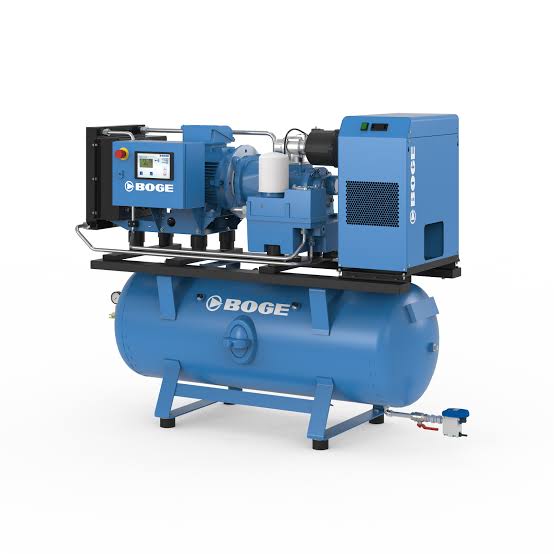
BOGE compressor technologies
Select the compression approach first, then review the model and controls against the system duty.
Oil-injected screw compressors
Support production areas and central air systems with sustained demand.
- Rotary screw compression
- Industrial compressed-air generation
- Compare control options against running hours
Oil-free screw compressors
Address applications that call for oil-free compression while maintaining continuous air supply.
- Oil-free compression approach
- Evaluate required air quality at the process
- Include downstream drying and filtration
Piston compressors
Review reciprocating technology for smaller consumption points and application-specific duties.
- Oil-free piston options
- K-series product information
- Review duty cycle and pressure requirements
Start with your operating requirements.
Match the running pattern
Document how often equipment uses air and whether demand is continuous or intermittent. A peak requirement alone does not describe the operating duty.
Protect the point of use
Specify the cleanliness and dryness required by the process. Include ambient conditions and the coldest downstream section of piping.
Plan room for maintenance
Share footprint, access, ventilation and power details so the compressor arrangement supports routine inspection and future expansion.
Frequently asked questions
Compare them when demand, operating hours or installation size is changing. Continuous plant-air service and intermittent workstations can favor different arrangements.
Horsepower is not enough. Compare delivered flow at the required pressure, duty cycle, controls, cooling and air-treatment requirements.
Provide the existing equipment model, pressure readings, demand pattern and the production issue you want to solve. Include space, power and air-quality constraints.
Related products and support
Compressed air audits
Understand demand, pressure losses and operating patterns before changing equipment.
Service, repair & rentals
Explore support for equipment condition, planned maintenance and temporary capacity.
Air treatment and distribution
Connect the compressor selection with drying, filtration, storage and piping.
Contact your local Fluid Flow team to confirm product availability and options for your facility.
Find the right solution for your application.
Share your operating requirements, current equipment and facility location.